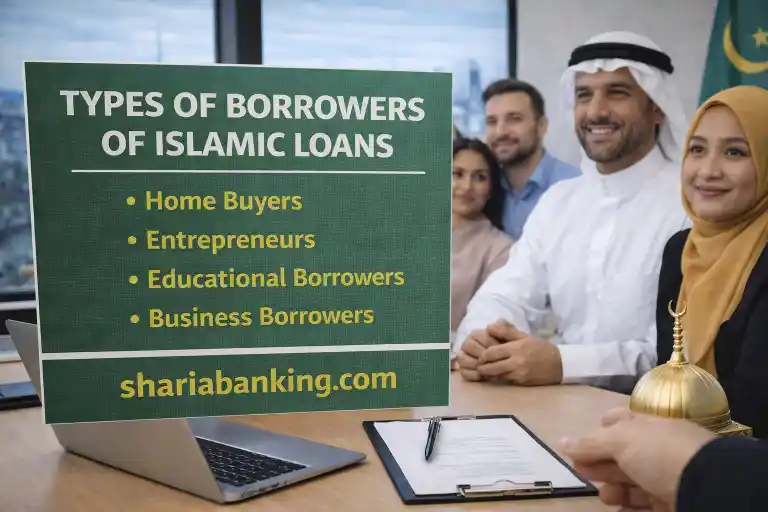
TYPES OF BORROWERS OF ISLAMIC LOANS
In Islamic finance, the types of borrowers of Islamic loans refer to clearly identifiable categories of individuals or entities eligible to access Sharia-compliant financing structures such as murabaha, ijara or musharaka, based on their economic role, ethical activity and ability to engage in asset-backed, non-interest-based transactions.
Objective of categorizing borrowers within Islamic financing frameworks
The classification of borrowers in Islamic finance aims to ensure that financing is directed toward legitimate economic activities, excluding speculative or prohibited sectors, while aligning each borrower profile with the appropriate contract structure that respects Sharia principles and risk-sharing requirements.
Operational logic: how borrower types are matched with Islamic financial contracts
Islamic lenders assess borrowers based on their profile, such as individual consumer, entrepreneur or corporation, and match them with financing models like murabaha for asset purchases, ijara for leasing or mudaraba for profit-sharing, ensuring the transaction remains compliant and asset-backed.
Individual consumers as borrowers in Islamic loans: eligibility and constraints
Individuals seeking personal financing are considered valid borrowers when the purpose involves tangible assets such as housing, vehicles or essential goods, with financing structured through cost-plus sales or leasing rather than unsecured cash lending with interest.
Business owners and entrepreneurs as core borrowers in Islamic finance ecosystems
Entrepreneurs represent a central category of borrowers, accessing financing through partnership-based contracts like musharaka or mudaraba, where profits and losses are shared, making them distinct from conventional borrowers who rely on fixed-interest obligations regardless of performance.
Corporate entities as structured borrowers in large-scale Islamic financing
Corporations qualify as borrowers when financing is linked to real economic activities such as infrastructure, trade or production, with Islamic contracts structured around asset ownership, leasing or joint ventures rather than debt-based interest mechanisms.
SMEs and micro-entrepreneurs as targeted borrowers in Islamic microfinance
Small and medium enterprises and micro-entrepreneurs are key borrower types in Islamic finance, often supported through simplified structures that promote financial inclusion while maintaining compliance, particularly in emerging markets with strong demand for ethical financing solutions.
Public sector and institutional borrowers in Islamic financing structures
Governments and public institutions are also considered borrowers when issuing sukuk or engaging in large-scale financing projects, provided the underlying assets and use of funds comply with Sharia principles and avoid prohibited activities.
Profiles excluded from Islamic borrowing: identifying non-compliant borrower types
Borrowers involved in industries such as alcohol, gambling, speculation or interest-based financial services are excluded from Islamic financing, as their activities conflict with Sharia principles, regardless of their financial strength or repayment capacity.
Key criteria defining valid borrower types in Islamic loan systems
Eligible borrowers must demonstrate involvement in permissible economic activities, the ability to engage in asset-backed transactions, financial transparency and compliance with ethical standards, ensuring that the financing structure remains aligned with Islamic legal and financial requirements.